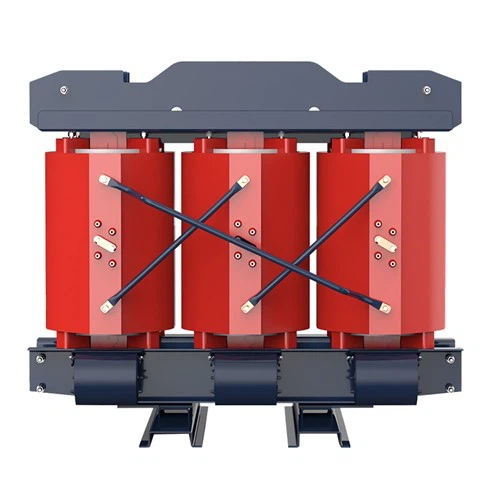
As a supplier of dry type transformers, I often get asked about the types of loads these transformers can handle. Dry type transformers are pretty versatile, and understanding their load - handling capabilities is crucial for anyone looking to use them in various electrical systems.
Let's start with the basics. Dry type transformers use air as the insulating medium instead of the oil used in traditional transformers. This makes them a great option for indoor use, in places like commercial buildings, hospitals, schools, and industrial facilities where oil spillage could be a major safety hazard.
Resistive Loads
Resistive loads are probably the most straightforward type of load that a dry type transformer can handle. These loads convert electrical energy into heat. Examples of resistive loads include electric heaters, incandescent light bulbs, and electric stoves.
When dealing with resistive loads, the current and voltage are in phase. This means that the power factor (PF) is close to 1. Dry type transformers are well - suited for resistive loads because they don't have to deal with the complications of reactive power. The transformer can efficiently transfer electrical energy from the primary to the secondary side without much loss. For instance, in a small office building with a lot of electric heaters, a dry type transformer can easily handle the resistive load, ensuring a stable and efficient power supply.


Inductive Loads
Inductive loads are a bit more complex than resistive ones. Devices like motors, transformers (yes, transformers themselves can be considered inductive loads in some cases), and solenoids fall into this category. Inductive loads cause the current to lag behind the voltage, resulting in a power factor that is less than 1.
When a dry type transformer is connected to an inductive load, it has to supply both real power (the power that does useful work) and reactive power (the power that is stored and released in the magnetic field of the inductive device). The transformer needs to be sized appropriately to handle the additional current caused by the reactive power. For large industrial facilities with multiple motors, choosing the right dry type transformer is essential. A transformer that is too small may overheat due to the extra current required by the inductive loads, while an oversized transformer can be inefficient and costly.
Capacitive Loads
Capacitive loads are the opposite of inductive loads in terms of the phase relationship between current and voltage. In capacitive loads, the current leads the voltage. Examples of capacitive loads are capacitor banks used for power factor correction, some types of electronic power supplies, and certain types of lighting ballasts.
Dry type transformers can handle capacitive loads, but similar to inductive loads, the power factor needs to be taken into account. Capacitive loads can cause the voltage to rise, and if not properly managed, it can lead to over - voltage conditions. However, when used in combination with inductive loads, capacitive loads can actually help improve the overall power factor of the electrical system. For example, in an industrial plant where there are many motors (inductive loads), adding capacitor banks (capacitive loads) can balance out the reactive power and reduce the stress on the dry type transformer.
Non - linear Loads
Non - linear loads are becoming more common in modern electrical systems. These loads include devices such as computers, variable frequency drives (VFDs), and LED lighting. Non - linear loads draw current in short pulses rather than in a smooth, sinusoidal waveform.
This non - sinusoidal current waveform contains harmonics, which are multiples of the fundamental frequency. The presence of harmonics can cause several problems for a dry type transformer. Harmonics can increase the copper and iron losses in the transformer, leading to overheating. They can also cause additional stress on the insulation, reducing its lifespan.
To handle non - linear loads, dry type transformers need to be designed with special considerations. Some transformers are designed with a higher k - factor rating, which indicates their ability to withstand harmonic currents. For example, in a data center filled with computers (non - linear loads), a dry type transformer with a high k - factor rating is necessary to ensure reliable and long - lasting operation.
Special Load Considerations
- Continuous Loads: Continuous loads are loads that operate for three hours or more continuously. Dry type transformers need to be sized to handle the continuous load without overheating. For example, in a hospital, where there are many critical electrical systems that need to operate 24/7, the dry type transformer must be sized appropriately to handle the continuous load of all the equipment.
- Intermittent Loads: Intermittent loads operate for shorter periods. These could be things like some types of industrial machinery that are only used during certain shifts. A dry type transformer for an intermittent load can be sized a bit smaller than one for a continuous load, as long as it can handle the peak load when the equipment is operating.
Our Product Range
We offer a wide range of dry type transformers to meet different load requirements. If you're looking for a transformer for medium - voltage applications, our 10 - 35KV Dry Type Distribution Transformer is a great option. It's designed to handle various types of loads in distribution networks, whether they are resistive, inductive, or a combination of different loads.
For more demanding power applications, our 35KV Dry Type Power Transformer is built to provide reliable power transfer with high efficiency, even when dealing with complex load scenarios such as non - linear loads.
Contact Us for Procurement
If you're in the market for a dry type transformer and need to figure out the right one for your specific load requirements, we're here to help. We have a team of experts who can analyze your electrical system and recommend the most suitable transformer. Whether you have a small commercial building or a large industrial facility, we can provide a solution that meets your needs. Don't hesitate to contact us for procurement discussions. We'll work with you to ensure you get the best dry type transformer for your application.
References
- Electric Power Systems: Analysis and Control by Claudio A. Cañizares
- Transformer Engineering: Design, Technology, and Diagnostics by George Karady and Gönül Görücü